

Katalin Boruzs has been leading the excavations on Sibrik Hill in Visegrád for many years, and countless enthusiastic visitors have already had the chance to hear her fascinating guided tours during the excavations’ open days. Her approachability and unwavering enthusiasm are a wonderful example of what it means when someone’s work is truly their passion.
—-
We ended our last conversation by mentioning that there would be a conference in Visegrád on 11 October 2023, organised by your research group. Was the event a success?
Yes, at that time we were preparing for the Sibrik X conference. This was the first occasion on which almost all the participants and fellow researchers involved in the Sibrik Hill excavation – which has been ongoing for ten years – attended and presented their findings. Not only were attendees able to listen to academic presentations, but our volunteer staff also introduced themselves – people who have been attending the Visegrád excavations for years (and, in some cases, decades). We received positive feedback from both the academic audience and the „general public”. Everyone encouraged us to organise such a meeting not just every 10 years, but more frequently. We are planning the next conference for spring 2025, by which time we will also be able to report on this year’s findings.
What has this year brought on Sibrik Hill? How is the excavation of this year’s 200 square metres progressing?
It went from 200 to 300 square metres because so many people wanted to take part in the excavation that we had to expand the site… Anyway, this year’s season went really well – we had a brilliant team!
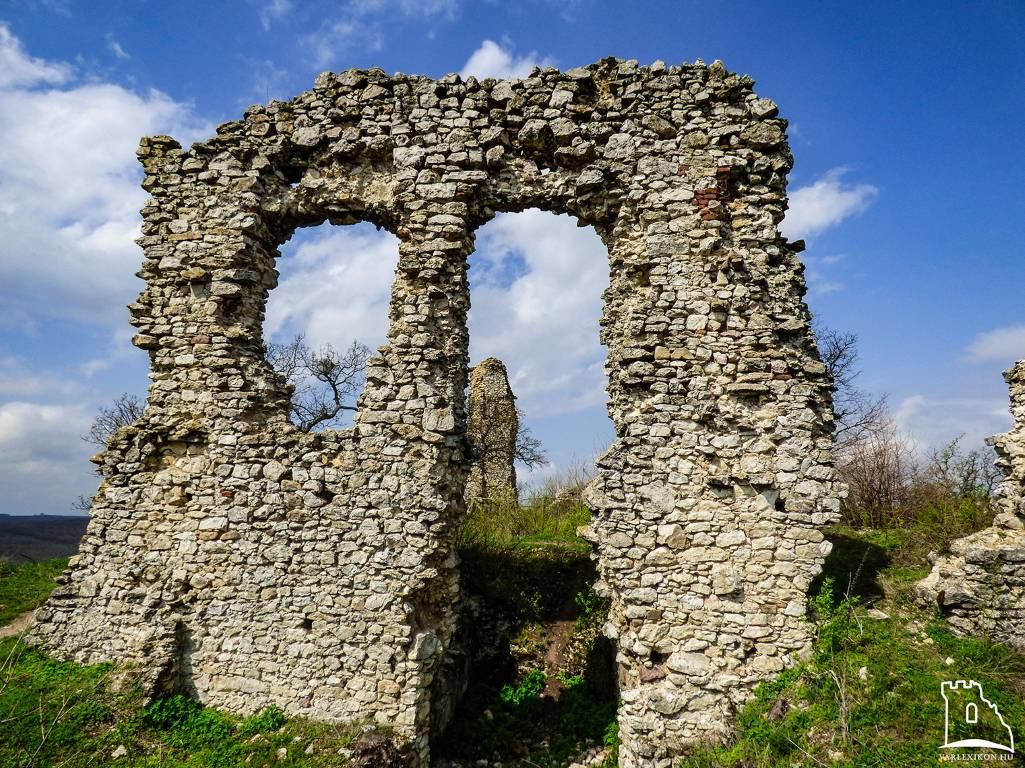
This year’s excavation site is surrounded by the 2018, 2020 and 2023 research zones, so we weren’t expecting too many surprises. In this section, there are two Roman-era buildings with stone walls, as well as the remains of a gravel-paved road between them. It is very exciting to discover that the building next to the camp wall had a drainage channel running beneath the floor, which was probably used to drain rainwater. The surrounding area was laid out so that it sloped down towards the water-collecting „pit”. In addition, four 10th–11th-century sunken houses have also been unearthed, which clearly indicates that the Roman-era stone-walled buildings were no longer in use during the Árpád period.
The collection of artefacts also contains a number of interesting items, such as: a Roman-era spearhead (plumbata) fitted with a lead weight, an Avar-period bone needle holder, a silver denarius of Saint Ladislaus, and a 20th-century lead seal (certification seal), bearing the inscription „Visegrád” on one side and „Sibrik” on the other.
The Benedetto Da Maiano find caused quite a stir. It was widely reported in the press and, as we have seen, caused quite a stir internationally too. Did this sensation have any impact on the excavations at Sibrik Hill that you were leading?
A layperson, like myself, might think that even the “shadow” cast by a highly celebrated collection of finds is very large, so that other ongoing projects may receive less attention or support during such periods. (Or, conversely: it is also possible that we tend to think of archaeology in general at such times, and if the topic goes “viral”, this automatically brings with it attention for other periods and areas.).
No, it didn’t really have any impact at all. The carvings came to light during the excavation carried out as part of the Visegrád 700 project, of which the Sibrik Hill research is not a part; so it was only natural that the latter were not included in the news reports. We didn’t feel any positive or negative impact, because we haven’t had any „major publicity” in previous years either, and we’ve been without substantial financial support for years. That hasn’t changed this year either…
Unfortunately, we have no financial backing whatsoever; this year’s excavation was once again carried out solely by volunteers, whilst the machinery (as has been the case for many years) was provided by the Visegrád Forestry Department of the Pilis Park Forest. At the same time, we received a high level of professional support from the National Archaeological Institute of the Hungarian National Museum (MNM KK), from which several technicians and archaeologists assisted with the work and provided the materials required for documentation and packaging. Furthermore, the Institute has undertaken to carry out a number of scientific analyses, including archaeobotanical, archaeozoological and malacological analyses, as well as laboratory tests, all of which are essential for the evaluation of the fieldwork.
How important do you think it is for archaeology and history to feature more prominently in everyday “public discourse”?
I believe that providing information, education (or, to use the old term, „public enlightenment”) and the involvement of laypeople in work processes are very important – to some extent; at the same time, however, it is essential to maintain professional credibility and professional oversight. But the two are not mutually exclusive. I do not think it is a good thing for the „scientist” to sit in an ivory tower and pontificate from on high, saying things that the majority of the audience do not even understand. If the public do not know what we do, how much work goes into achieving a particular result, and what the point of it all is, then they cannot properly appreciate it. That’s when we hear comments like „what’s the point of this?”, „why do we need to do this?” (e.g. archaeological salvage before construction), „it’s just a waste of money” or „you can come and dig a hole in my garden too”, and so on. Obviously, there is a significant difference in knowledge between an expert in the field and a layperson (and there has to be!!), but even an amateur can take things very seriously. A good example of this is the increasingly thriving ‘scientific’ aspect of community archaeology, where volunteers give presentations of a scientific standard on the topics they have researched, or collaborate with archaeologists on a project. (See, for example, the highly successful Community Archaeology Conference series.) This does not make them qualified archaeologists, but it enriches the field of archaeology through a better understanding of a site or a group of artefacts. So everyone benefits. The key lies in mutual respect and collaboration.
Another very important area is museum education, which conveys scientific findings in an „accessible” form, whether through digital tools or live presentations. This is where children’s attention can best be held, but for that very reason there is a great responsibility to ensure that this forum does not descend into sensationalism.
Since when have you been interested in archaeology? Did you already decide during your secondary school years that this would be the path you would take?
No, I didn’t want to be an archaeologist. For a long time, I didn’t know exactly what I wanted to do. It became clear as early as primary school that I didn’t like science subjects, but I was interested in history, particularly ancient and medieval history. That’s why, at secondary school, I studied Latin as well as English. At the same time, I worked in a restoration workshop, which I really grew to love. I was fascinated by the way something dirty, torn or broken could be transformed into a beautiful object. A vast amount of knowledge of history, art history, cultural history, industrial history and other fields is required to assess each unique object and determine the best method of cleaning and restoration. I didn’t stand much of a chance of getting into a professional restoration course, so in the end I applied to study history at ELTE. In my second year, I also took up museology, in the hope of getting closer to the world of museums. Then, during the summer holidays, I went on an excavation in Szabadbattyán, which really captivated me. Those two weeks turned into a month, then two months, and by January I was sitting the entrance exam. My now husband helped me prepare…
Who had the greatest influence on you during your university years?
First and foremost, I must mention Gabriella Nádorfi, whose excavation site was where I decided I wanted to become an archaeologist. Her dedication, professional rigour and perseverance made her my role model. It was from her that I learnt to believe in and accept an appealing theory as fact only if it can be substantiated from every angle, beyond any doubt. At university, I was greatly influenced by Dénes Gabler, the renowned professor of Roman-era archaeology, who, despite his vast knowledge and international renown, remained a very modest and approachable man. He set an example to everyone through his professional humility and humanity. Apart from him, I particularly enjoyed the lectures given by Zsolt Mráv, an archaeologist at the Hungarian National Museum. He presented even a seemingly dull topic in such a way that it completely captivated the audience.
Which excavations, collections of artefacts or individual artefacts have had the greatest influence on you during your career to date?
Firstly, I would like to mention Gabriella Nádorfi’s excavation at Szabadbattyán. This is a Late Roman building complex covering several thousand square metres, which came to public attention in connection with the Seuso Treasure.
The site’s size, the artefacts found there and its scientific significance were all impressive. Years later, I took part in the excavation of the Roman-era military camp at Szentendre – the former Ulcisia – where I was able to experience first-hand in the field what we had learnt in military history lectures at university. In 2008, I had the opportunity to take part in the excavation led by Péter Gróf and Dániel Gróh at the Lepence beach area, where a Roman-era settlement, a Bronze Age cemetery and the remains of an 18th-century mill were unearthed. At the time, I had no idea what a long-term impact this work would have! Once the excavation was complete, the excavation leaders offered me the opportunity to catalogue the Roman-era finds, and now this collection (and the site itself) forms the basis of my forthcoming doctoral thesis. Later, during the few years I spent at the Szekszárd Museum, I came across artefacts from several different periods whilst carrying out salvage excavations and motorway excavations. Perhaps one of the most interesting was the excavation of the Bronze Age graves at Bonyhád. Under the guidance of archaeologist Géza Szabó, I learnt a great deal there. And last but not least, I would highlight the research at Sibrik Hill. On the one hand, because the site itself is extremely complex; on the other, it was through the start of the excavations there that I came to work at the Visegrád Museum.
Have you ever found anything underground that raised more questions than it could answer?
Every year I come up against this on Sibrik Hill: the more I delve into the subject and the site, the more questions arise, and the more I realise just how little I know. This year, for example, assessing the small ditches of varying sizes and orientations found between the two Roman buildings, and determining their function, is proving a real headache. A few years ago, the discovery of minting dies and a trial strike in one of the sunken houses raised many questions: could it have been an official mint or a counterfeiter? To which period exactly can it be linked, and who might have used it? Why was a mint belonging to the royal centre located in Visegrád? … and I could go on. Often, we are only able to answer a particular question years later, when new evidence comes to light during the excavation, or when we manage to find parallels at another site. It’s like a detective investigation.
What else do you enjoy doing when you’re not out on an excavation, giving a lecture or carrying out museum duties?
Unfortunately – or perhaps fortunately – my work is also partly my hobby, so there have been times when I’ve gone along to a colleague’s excavation just for a change of pace. The good thing about these occasions is that I’m not responsible for the organisation or many other tasks – I can just focus on the archaeology. I’ve still retained my passion for restoration, and I really love plants – I adore gardening. It’s a great way to unwind when I can be out in nature, in the fresh air. If the weather’s bad, I prefer to read by the stove.
The interview was conducted on behalf of the Visegrád and Surrounding Area Tourism and Marketing Association by:
Róbert Fagyas
2 December 2024.