

Imre Makovecz’s Visegrád (Part 1)
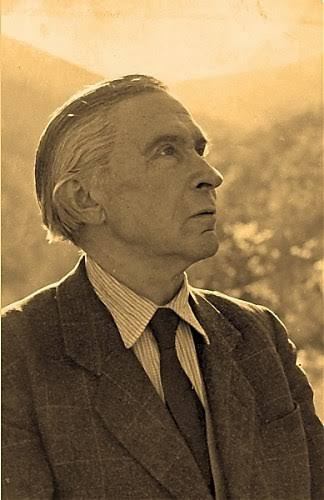
The five buildings designed by Imre Makovecz form an emblematic part of Visegrád’s built heritage. Thousands of people visit Visegrád every year specifically to see these works, so our mini-series is aimed primarily at them, as well as at anyone interested in 20th-century architecture, and specifically in the organic style for which Makovecz is renowned in Hungary.
Our town is fortunate enough to be the place where the legendary master built the Mócsai Farm, the Erdei Cultural Centre, the Mogyoróhegy Restaurant, the terrace complex of the Nagyvillám Restaurant, and perhaps the most famous of the five, the László Magyar Sports Hall. A distinctive feature of Makovecz’s buildings is that they can be identified almost with absolute certainty at first glance. It is true, of course, that organic architecture—which developed mainly in the wake of Art Nouveau, on the ruins burdened by the 20th century—exhibits unmistakable stylistic elements and characteristics in its own right; yet: neither a Hundertwasser building nor even a Medgyaszay building can really be confused with a Makovecz design, which is unique in every detail and offers a succession of new and distinct ‘island experiences’.
For twenty years from 1981, he organised the so-called Visegrád Campt. By the time he was running his building camps, he had already fully committed himself to that branch of organic architecture which became his hallmark in terms of his life’s work; and, thanks to his teaching, he continues to be a major influence on Hungarian organic architecture to this day. He spent a very significant part of his childhood in Nagykapornak, and it is likely that folk art had a profound influence on him even at that time. Folk motifs and structural features recur time and again in his works, yet the most striking recurring element is his extensive use of wood. His buildings truly give the impression of having „grown” from the very spots for which they were designed.
The Mócsai Farm
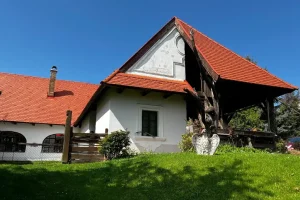
This fascinating residential complex on Mogyoró Hill in Visegrád is in fact a U-shaped farmhouse which, through its folk-classical design, reveals its inner core, whilst outwardly it blends ever more seamlessly with the trees of the forest, as if reaching out with its arms towards nature.
Anyone looking for regional characteristics, or trying to pinpoint the historical period represented by the building, is on the wrong track. The Mócsai Farmstead is, in fact, an artistic memento that reminds us of the immense fragility of the Hungarian people, and of the unalterable unity that binds man and nature together in the constant cycle of life.
Source: makovecz.hu
Source of photos: wikipedia.hu
2025.04.11.